Guide
Cold foil vs hot foil stamping: when to choose which (and what The Label Shoppe does)
Most label briefs that ask for "foil" don't say which kind. Cold and hot foil look alike but price and schedule very differently. When to choose which.
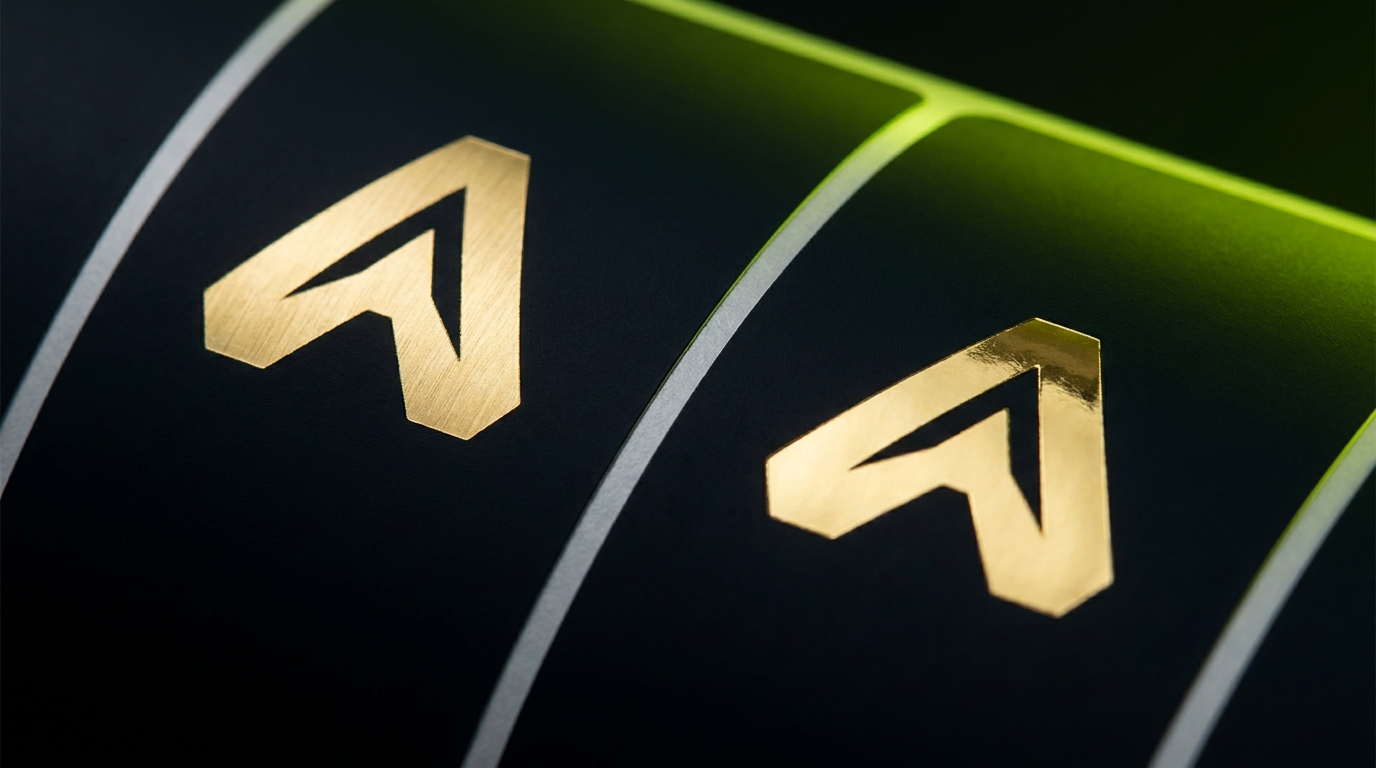
Most label design briefs that ask for "foil" don't specify which kind. They just say "gold foil" or "metallic accent" or "foil-stamped" and assume the printer will know what to do. Half the time, neither the brand team nor the printer fully untangles which process they're actually using until plates are being made and a per-unit cost comes back that's three or four times higher than the brand budgeted.
There are two genuinely different processes that produce metallic-foil effects on labels, and they're not interchangeable. One uses a heated brass die to stamp metallic foil onto the label surface. The other uses ultraviolet-cured adhesive plus a metallic foil donor film that bonds in line with the printing press. They produce similar visual results in many cases, but the production economics, lead times, and design constraints are fundamentally different. Brands routinely overpay for one when the other would have delivered the same shelf result for a fraction of the cost — or vice versa, accept a cheaper substitute that doesn't actually carry the brand register the campaign needed.
This is the breakdown most label printers don't put on their website.
Hot foil stamping: what it is, what it costs
Hot foil stamping is the traditional foil decoration process. A pre-fabricated metallic foil donor sheet (typically a polyester carrier coated with a thin metalized layer plus a heat-activated adhesive) is positioned over the label substrate. A heated metal die — usually brass or magnesium, machined to the foil-shape design — presses down on the foil donor, transferring the metallic layer to the label where the die contacts.
The visual result: a true foil deposit on the substrate surface, with the depth and sharpness of a stamped impression. Hot foil produces the visual register that fine-wine, prestige spirits, and luxury cosmetics decorating has used for decades. It can also be combined with embossing (the same die that stamps the foil also deboss-deepens the substrate) to produce a three-dimensional tactile result that's hard to fake.
The economics are different. Hot foil requires:
- A custom metal die for each design. The die has to be machined to match the foil-shape artwork, which adds setup cost (typically $300–$1,200 per die) and 7–14 days of lead time before the run can start.
- Specialized hot-foil equipment. Not every label printer runs hot-foil presses. The ones that do invest in heated registration systems, foil-donor handling, and the operator training to keep registration tight at production speed.
- Higher per-unit cost at most volume tiers. Foil donor consumption per impression is meaningful, the die wears down with each cycle, and the press throughput on hot-foil setup is slower than standard print processes.
Where hot foil makes sense: high-value, low-volume products where the per-unit foil cost is absorbed by a premium SRP. A $90 wine bottle can absorb $0.40 of hot-foil decoration without changing the gross margin meaningfully. A $4.99 specialty sauce cannot.
Cold foil: what it is, what it changes
Cold foil delivers a foil effect without heat, without a custom die, and without the lead-time and per-unit cost structure of hot foil. The process: a UV-curable adhesive is printed on the substrate in the exact shape of the desired foil decoration, the substrate passes under a metalized foil donor roll where the adhesive picks up the foil layer, and UV lamps cure the adhesive instantly to lock the foil in place.
What this gives you:
- No custom die required. The foil shape is determined by the printed adhesive pattern, which can be changed digitally without new tooling. Design revisions don't require a die remake.
- Inline integration with the printing press. Cold foil happens during the same press pass as the rest of the printed content. No separate hot-stamp step, no transfer between presses, no additional registration alignment.
- Faster turnaround. No 7–14 day die lead time. A cold-foil job can quote and produce in the same timeline as a standard digital or flexo print run.
- Lower per-unit cost at most volume tiers. The foil donor consumption is similar to hot foil, but the elimination of die cost and the faster throughput make cold foil typically 30–60% cheaper per unit at SMB-to-mid-market volumes.
The visual result: a metallic foil deposit on the substrate that, in most lighting conditions and at most viewing distances, reads as foil. Side-by-side with hot foil under critical inspection, an expert can spot differences — cold foil typically has a slightly softer edge and a slightly thinner metallic deposit, and it doesn't combine with deep embossing. But on a shelf, in a customer's hand, in a product photograph, the visual register is the same.
Where cold foil makes sense: any SMB-to-mid-market CPG product where a metallic accent is part of the brand identity and the design timeline doesn't accommodate a 7–14 day die lead. Beauty, supplements, specialty food, craft beverage, premium pet, household and personal care brands where "foil" is part of the brand register but a $0.40 per-unit hot-foil decoration would compromise margins.
The visual question: can a customer tell the difference?
Honestly, in 90 percent of CPG retail conditions, no. The shelf-distance reads identically. The product photograph reads identically. The pickup-and-turn reads identically.
The 10 percent where it matters: when the foil design is paired with a deep emboss/deboss that produces a three-dimensional tactile result. Cold foil can't be combined with deep embossing in the way hot foil can — the UV-cured adhesive system doesn't tolerate the deformation. A luxury fragrance bottle hangtag with a stamped-and-embossed brand mark cannot be replicated by cold foil. A premium spirits label with a deep-bossed bottle vintage panel cannot be replicated by cold foil.
Outside those specific tactile-decoration use cases, the cost-and-lead-time delta of cold foil is doing the same brand work at a fraction of the production tax.
A third option: silver BOPP substrate
There's a third path that often outperforms both hot foil and cold foil for craft and SMB brands: print on silver BOPP (biaxially oriented polypropylene) substrate. The metallic silver appearance is part of the face stock itself, not a separate foil layer. Any non-foil printed content drops behind, on top of, or around the silver — and the brand mark reads as foil because the substrate IS metallic.
Silver BOPP gives you the foil-shelf-register at the substrate cost (not the foil cost), with no die requirement, no lead-time impact, and complete design flexibility on where the metallic "appears" relative to the printed content. The trade-off: the metallic register is uniform across the substrate, so you can't have a foil accent surrounded by a non-foil background — it's all metallic, with the printed content sitting on top.
For specific use cases — beverage labels with metallic accents around a brand mark, supplement labels where the entire brand sleeve reads metallic, premium snack pouches with metallic shimmer — silver BOPP outperforms both hot foil and cold foil on cost and timeline while delivering the same shelf result.
How to decide
Three questions get you to the right answer.
Question 1: Does your brand decoration include a deep emboss or deboss combined with the foil decoration? If yes, hot foil is the answer. There's no cold-foil or BOPP equivalent for stamped-and-embossed three-dimensional effects.
Question 2: Is the foil shape complex, varying across SKUs, or likely to change between reorders? If yes, cold foil wins. Cold foil eliminates die tooling — your foil decoration can vary per SKU or per release without redoing dies. Hot foil requires a new die for each shape change.
Question 3: Is the entire substrate "metallic" (a continuous metallic background), or is the metallic decoration localized to specific design elements? If continuous metallic, silver BOPP is the most economical answer. If localized decoration, cold foil or hot foil is the answer.
What The Label Shoppe runs
We run cold foil. We run silver BOPP. We run a wide range of specialty substrates with topcoat and surface treatments that simulate foil effects (laminated coated stocks, metallized BOPP variants, polyester options).
We do not run hot foil stamping. That's deliberate. The equipment investment and the operating profile of hot-foil decoration fit a different customer base than the SMB-to-mid-market CPG buyers we serve. The customers we work with don't need hot foil capability often enough to justify carrying it.
When a brand brief requires hot foil specifically — paired with deep embossing, or for a luxury-tier launch where the customer has tested cold foil and determined it doesn't deliver the visual register the campaign needs — we say so directly. We don't run that work, and we'll tell you that on the quote call rather than route the request through a partner subcontracting layer.
For the other 95 percent of cases where "foil" is the design ask, cold foil and silver BOPP do the job. Same shelf register. Lower per-unit cost. Faster turnaround. No custom dies, no separate decorating step, no lead-time tax on design iteration.
The decision in practice
A specialty hot sauce brand approaches us with a foil-decorated label design — gold metallic detail around a brand wordmark on a black uncoated label stock, 8,500-unit initial run, 90-day repeat reorder pattern. A hot foil quote would land around $0.18–$0.22 per label including die amortization for the first run, dropping slightly on reorders as the die cost amortizes. A cold foil quote lands around $0.07–$0.09 per label — same visual register, no die, no lead-time penalty on design changes.
Over the brand's first-year volume (estimated 50,000+ units across initial run and reorders), the cold-foil decision saves them roughly $5,000–$6,500. The shelf result is indistinguishable to anyone outside the print industry. The brand owner makes the call.
That's the conversation that should happen on every "foil" brief. Most label printers don't have it because they don't want to talk customers out of the more expensive option. We do, because we'd rather earn the next 20 reorders than win the first one at a price the brand can't sustain.
Quotes in 4 hours or less. Decision-makers in minutes. Cold foil on the same press calendar as your standard PS run.
// READY TO PRINT
Need labels for your project?
Quotes in 4 hours or less. Decision-makers in 2 minutes or less. Independent since 1991.