// INDUSTRY
Industrial & Chemical labels
When this label fails, it costs more than a reprint.
The Label Shoppe prints BS5609-rated, chemical-resistant labels for industrial and chemical products, including drum, pail and tote labeling. Quotes come back within 4 business hours of complete specs.
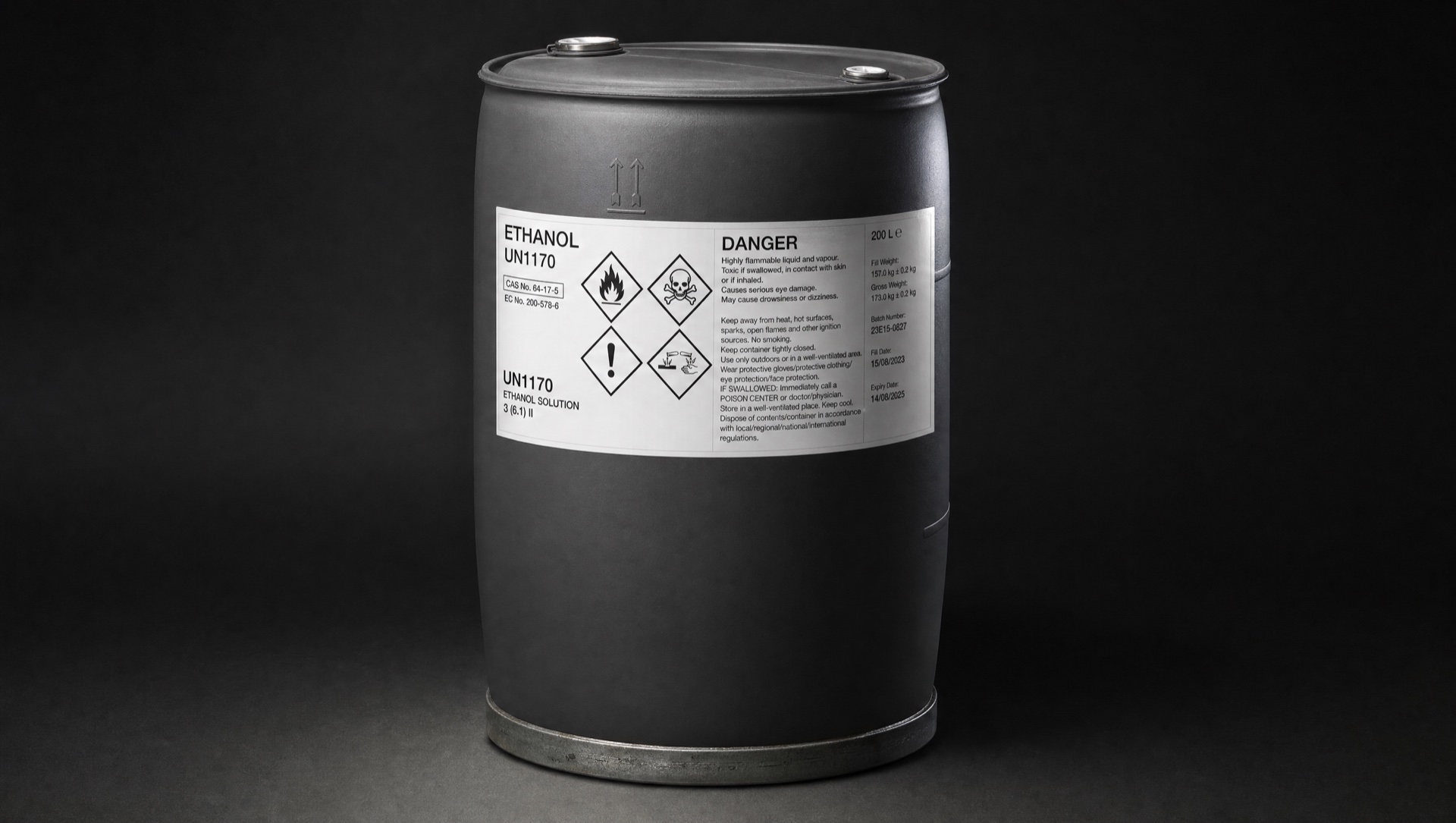
Industrial and chemical labels fail in expensive, regulatory ways. A peeled drum label triggers an OSHA citation. A faded GHS pictogram fails a DOT roadside inspection. A smudged batch code stops a customs port of entry. An adhesive that fails on a 55-gallon drum stored outdoors for six months turns a shipment into a hazmat liability. The label isn't a marketing surface in this category — it's a compliance instrument that has to survive marine immersion, 18 months of UV, chemical splash, and forklift abuse. We've built the substrate program, the press capability, and the pre-press review process to treat it as a primary line.
What we do for industrial & chemical brands
Industrial label work demands a substrate program designed around failure prevention. Adhesives that hold to powder-coated steel, untreated polyethylene drums, aluminum totes, and HDPE pails. Face stocks that survive UV exposure on outdoor-stored chemical pails for 18 months without color shift. Inks that don't smear under condensation. Print quality that holds GHS pictogram color and shape integrity through chemical splash and abrasion. We've built the program for that.
Pressure-sensitive labels on BS5609-rated marine-immersion substrates for ocean-freight chemical shipments. UV-stable inks for outdoor-stored industrial products. Chemical-resistant face stocks (cast vinyl, polyethylene, polyester) and adhesives engineered against solvents, oils, acids, alkalis, and isopropyl wipe-down. GHS pictogram printing with the diamond-frame red and proper hazard-class symbol rendering. Variable data for batch codes, manufacture dates, expiration, lot tracking, and serialization. Drum, pail, tote, and IBC labeling — sized to the surface and your spec, not to a generic SKU sheet.
An industrial chemical manufacturer doesn't need a vendor that treats every order as a one-off quote. They need a printer that knows which substrate-adhesive combinations survive their specific chemistry, who reads SDS sheets as part of pre-press, and who keeps a tested run of artwork on file from order #1 forward.
What your label has to carry
Your category has its own rules, and your regulatory and safety teams know them better than we do. The GHS elements under OSHA's HazCom standard: signal word, hazard pictograms, hazard and precautionary statements, product identifier. DOT markings for anything that ships under hazmat designation. IMDG requirements for marine shipments. EPA registration and establishment numbers under FIFRA. Prop 65 disclosures, state Right-to-Know language, NFPA 704 ratings, and destination-country export labeling.
What we bring to it: we have access to materials meeting dozens of different regulatory standards in every industry. And a pre-press review that checks every proof against the spec you approved, with every change between revisions flagged.
What we don't do (and who we're not for)
If your industrial brand strategy hinges on traditional hot foil stamping, deep emboss/deboss, or decorative shelf-facing visual effects, we're not your shop — and frankly, the industrial category rarely needs them. The category's design language is functional: clear hazard communication, scannable batch codes, and substrate durability that survives a year on a warehouse floor. That's what we do.
That's a fit if you're an industrial chemical manufacturer, automotive fluids brand, lubricant and grease producer, industrial coatings or paints maker, agricultural chemical supplier, cleaning chemical formulator, or hardware-channel consumer chemical brand serving SMB to mid-market volumes through industrial distributors, automotive parts channels, ag co-ops, hardware retail, or DTC industrial e-commerce. It's not a fit if your strategy is built on prestige-decorating effects — but it shouldn't be, for this category.
Working rhythm
A typical industrial chemical account looks like this with us. Discovery call to understand your hazard classification footprint, destination markets, container types, substrate-adhesive needs, SDS workflow, and reformulation cycle. First-job quote returned within 4 business hours of complete specs. Pre-press review with human eyes on every label: check against the spec and artwork you approved, with every change between revisions flagged, plus BS5609 substrate confirmation for marine shipments, color separation review, and die-line confirmation. Digital production for short runs and regional variants, flexo for steady high-volume drum and pail labels. The same account team stays on your program from order #1 forward, so when you call about Rev 9 of a degreaser label we printed three years ago, we know what you're talking about.
No call center. No ticket queue. No "let me check with the team and circle back."
// READY TO PRINT
Need labels for your industrial product line?
One call. Consider it done.